the good man
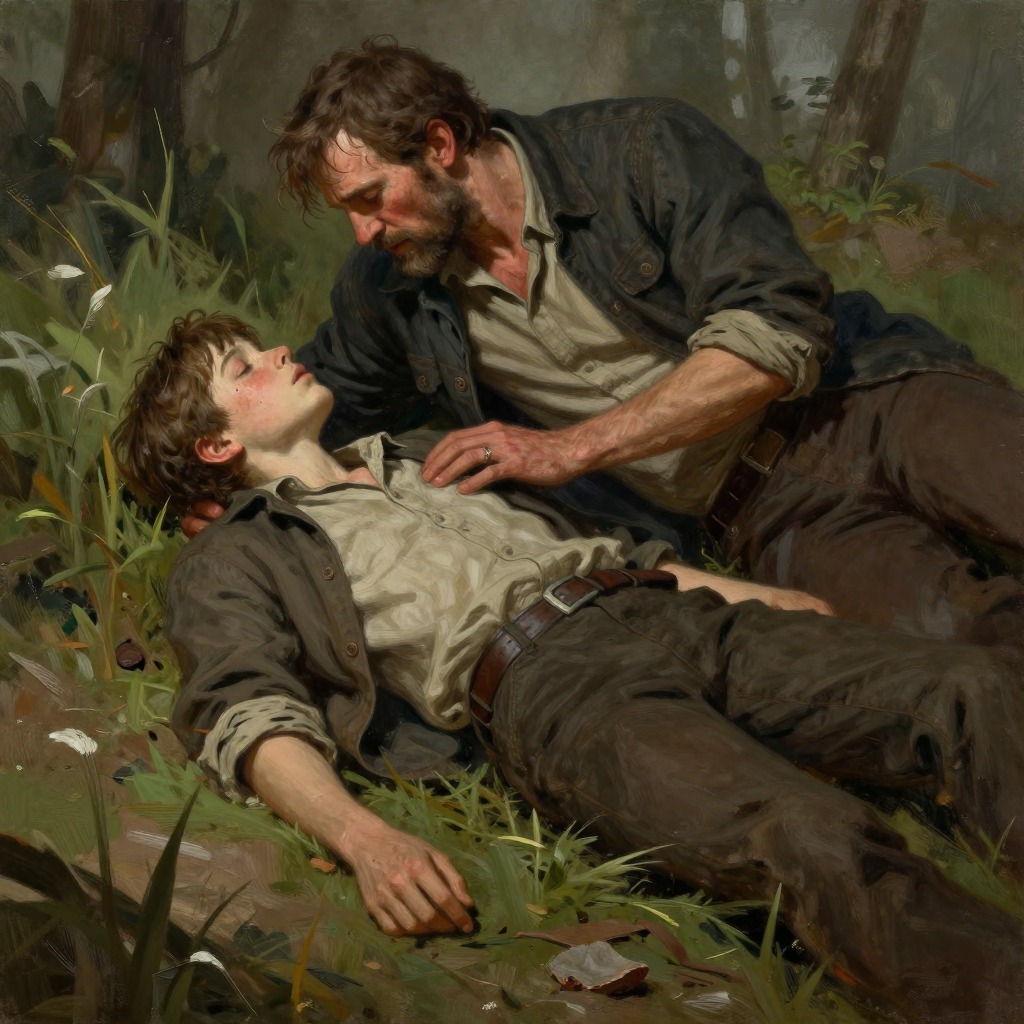
The good man is the final human figure the boy encounters after his father's death, a bearded, scarred veteran of the ruined world who carries a shotgun and a nylon bandolier of handloaded shells. He appears on the road just as the boy, having kept vigil over his father's body for three days, is about to set out alone. The good man's arrival resolves the novel's central question of whether the boy will find any other "good guys" and whether the fire the boy carries can be passed on.
Appearance and Bearing
The good man is dressed in a gray and yellow ski parka and carries a shotgun upside down over his shoulder on a braided leather lanyard. He wears a nylon bandolier filled with shells for the gun, the ends of the handloaded rounds sealed with candlewax. His face is marked by old violence: he is bearded, scarred across his cheek, with the bone stoven beneath the scar and one eye wandering. When he speaks, his mouth works imperfectly, and when he smiles the same impairment is evident. He smells of woodsmoke, a scent that signals warmth, shelter, and human presence in a world otherwise defined by cold and ash.
Encounter with the Boy
The good man finds the boy standing alone in the road, the pistol in his hand. He asks where the man the boy was with has gone, and the boy tells him his father has died. The good man expresses sorrow and says he does not know what to do, but then offers a direct choice: the boy can stay with his papa and die, or he can come with the good man. The boy, testing the stranger against the moral code his father taught him, asks directly: "Are you one of the good guys?" The good man pulls back his hood, looks at the sky as if searching for something, and then answers, "Yeah, I'm one of the good guys." He asks the boy to put the pistol away, not because he wants it, but because he does not want it pointed at him. The boy, still cautious, asks if the good man is "carrying the fire"—the phrase his father used for the moral mission of goodness. The good man, initially confused, confirms that he and his family are indeed carrying the fire. He reveals that he has a little boy about the boy's age and a little girl, and when the boy asks if they eat people, the good man answers firmly: "No. We don't eat people."
Role as Rescuer and Moral Confirmation
The good man's function is not to replace the father but to confirm that the father's teachings were true. The boy had been told by his father that there were other good guys, that they were hiding, and that the fire was real. The good man's arrival validates that promise. He does not take the pistol from the boy, telling him to hold onto it. He retrieves the boy's suitcase and blankets from the woods, and when the boy asks to say goodbye to his father, the good man waits patiently on the road. He covers the father's body with a blanket as promised, and then leads the boy away. The good man's scarred face and wandering eye mark him as someone who has survived violence, but his actions—his patience, his honesty, his refusal to take the boy's gun, his confirmation that he has children and does not eat people—establish him as a figure of trustworthy authority in a world where trust is nearly impossible.
The Good Man's Family and the Boy's New Life
The good man brings the boy to a woman who embraces him and says she is glad to see him. This woman, the good man's wife, talks to the boy about God and tells him that the breath of God is his breath yet, passing from man to man through all of time. The boy continues to talk to his father every day and does not forget him. The good man's family—a little boy and a little girl—provides the community the father had always hoped for. The good man does not speak much after the initial encounter; his role is to be the vessel through which the boy is returned to human society. He is the living proof that the father's faith in goodness was not misplaced, and that the fire the boy carries can be shared.
Thematic Significance
The good man represents the novel's fragile hope that goodness survives not as an abstract ideal but as a concrete practice embodied in small communities. He is not a hero in any conventional sense—he is scarred, imperfect, and his family has clearly endured terrible things—but he is willing to take in a starving, orphaned child. His appearance answers the boy's repeated question about whether there are other good guys, and it allows the boy to fulfill his father's final instruction: to carry the fire. The good man's family becomes the new context in which the boy can continue to be good, to talk to his father, and to believe that the world, though broken, still contains the possibility of love and care.